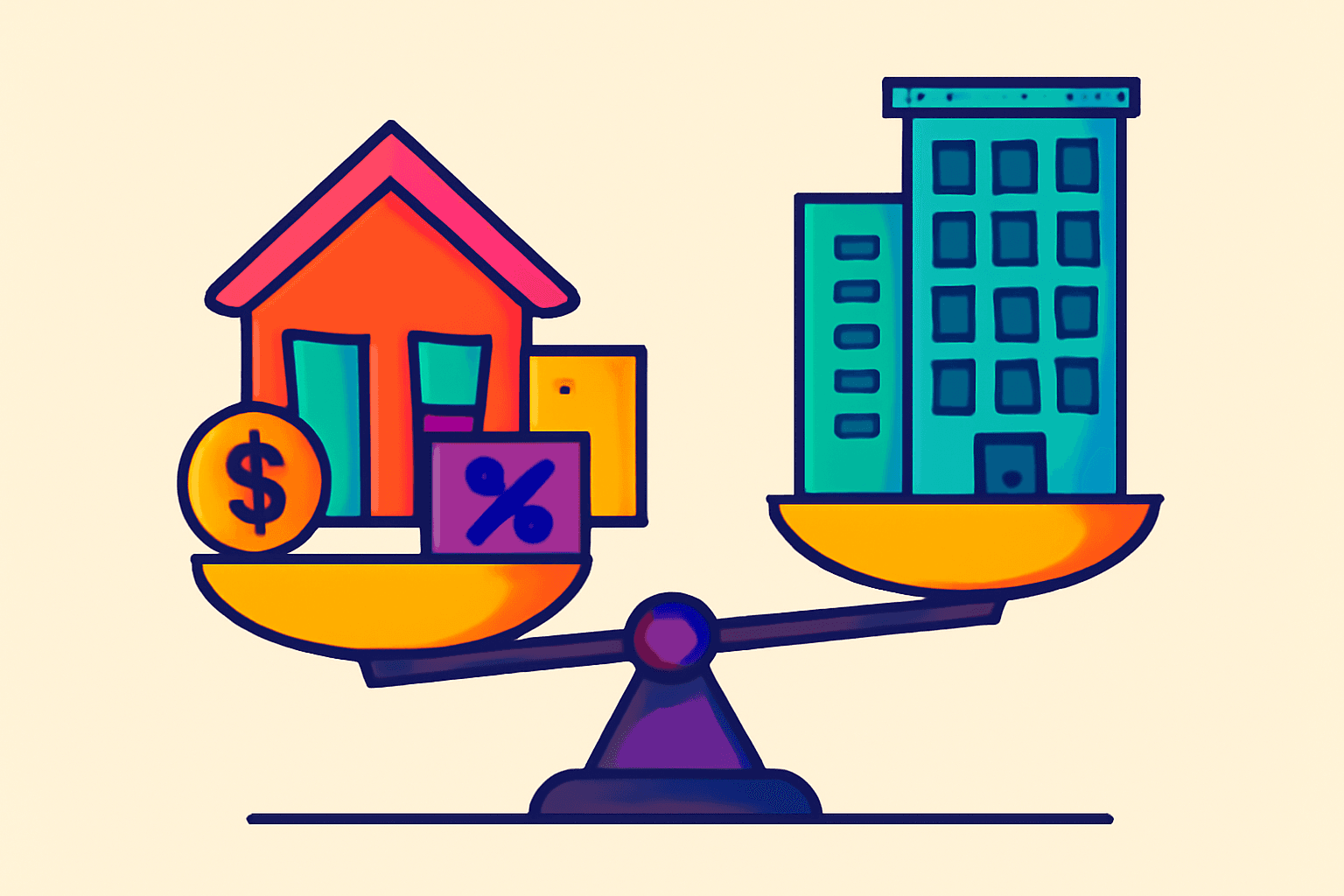
Renting vs. Buying in 2026: The Math No One Talks About
"You're throwing money away on rent." If you've heard that line from a well-meaning relative, a coworker, or a real estate agent, you're not alone. It's one of the most persistent pieces of financial advice in America, and it's also one of the most misleading.
The truth is that both renting and buying have real costs, and the right choice depends on your numbers, your market, and your life. Let's break down the math that most rent-vs.-buy calculators conveniently leave out.
The True Total Cost of Buying a Home
Most people fixate on the mortgage payment when they think about the cost of homeownership. But the mortgage is just the starting point. Here's what you're actually paying when you buy a home in 2026.
Mortgage Principal and Interest
With 30-year fixed rates hovering around 6.25%-6.75% in early 2026, a $400,000 home with 20% down ($80,000) means a loan of $320,000. At 6.5%, your monthly principal and interest payment is roughly $2,023. Over 30 years, you'll pay about $408,000 in interest alone — more than the original loan amount.
Property Taxes
Budget 1%-2.5% of your home's value per year, depending on your state and municipality. On a $400,000 home, that's $4,000-$10,000 annually, or $333-$833 per month. And property taxes tend to rise over time as your home is reassessed.
Homeowner's Insurance
Expect to pay $1,500-$4,000+ per year depending on location, coverage, and the property itself. In disaster-prone areas, premiums have surged dramatically in recent years, and some markets have seen increases of 30-50% since 2023.
Private Mortgage Insurance (PMI)
If you put less than 20% down, add 0.5%-1.5% of the loan amount per year until you reach 20% equity. On a $380,000 loan (5% down on a $400,000 home), that could mean an extra $158-$475 per month.
Maintenance and Repairs
The standard rule of thumb is 1%-2% of your home's value per year for upkeep. That's $4,000-$8,000 annually on a $400,000 home. Roofs, HVAC systems, plumbing, and appliances don't care about your budget — they break when they break.
The Opportunity Cost of Your Down Payment
This is the cost almost nobody talks about. That $80,000 down payment isn't just money you spent on a house. It's money that could have been invested. If you had put $80,000 into a diversified index fund earning a historical average of 7% annually after inflation, it would grow to roughly $160,000 in 10 years and $314,000 in 20 years.
The opportunity cost of tying up that capital in a single, illiquid, leveraged asset is real, and it compounds every year.
Transaction Costs
When you eventually sell, expect to pay 5%-6% in agent commissions plus closing costs, title insurance, and transfer taxes. On a $500,000 sale, that's $25,000-$30,000 walking out the door. Buying has its own closing costs too, typically 2%-5% of the purchase price.
Add it all up, and the true monthly cost of owning a $400,000 home is often $3,200-$4,200+ — well above the mortgage payment alone.
The True Cost of Renting
Renting has costs too, but they're simpler and more predictable.
Monthly Rent
In 2026, the national median rent for a two-bedroom apartment is roughly $1,800-$2,200, though this varies enormously by city. Rent tends to increase 3%-5% per year on average, though rent control and market conditions can change that.
Renter's Insurance
A basic policy runs $15-$30 per month — a fraction of homeowner's insurance.
The Big Advantage: Investing the Difference
Here's the key that changes the entire equation. If renting costs you $2,000 per month and buying would cost $3,500 per month (all-in), you have $1,500 per month to invest. At a 7% average annual return, that $1,500/month invested consistently turns into roughly $260,000 in 10 years and $783,000 in 20 years.
This is the "invest the difference" strategy, and it's what makes renting financially competitive — or even superior — in many high-cost markets. The catch? You actually have to invest the difference. If you spend it, the math falls apart.
The 5-Year Rule
One of the simplest and most useful guidelines in the rent-vs.-buy decision is the 5-year rule: don't buy unless you're confident you'll stay in the home for at least 5 years.
Why? Because the transaction costs of buying and selling are enormous. Between closing costs on the purchase, agent commissions on the sale, and the fact that your early mortgage payments are almost entirely interest, it typically takes at least 5 years before you start coming out ahead versus renting — and in many markets, it takes 7-10 years.
If there's a reasonable chance you'll relocate for work, outgrow the home, or want to move for any other reason within 5 years, renting is almost certainly the smarter financial move.
The Price-to-Rent Ratio: Your Market Matters
The price-to-rent ratio is one of the best tools for evaluating whether buying makes sense in your specific market. Here's how it works:
Price-to-rent ratio = Home price / Annual rent for a comparable property
- Below 15: Buying is generally favorable
- 15-20: It's a toss-up; run the numbers carefully
- Above 20: Renting is likely the better financial deal
For example, if a home costs $400,000 and a comparable rental is $2,000/month ($24,000/year), the price-to-rent ratio is 16.7 — a gray area where the decision depends on your specific circumstances.
In cities like San Francisco, New York, and San Jose, the ratio often exceeds 25-30, meaning buying is extremely expensive relative to renting. In cities like Cleveland, Detroit, and Memphis, the ratio may be below 12, making buying much more attractive.
Check your local ratio before making any decisions. National averages are nearly useless here because real estate is hyper-local.
Lifestyle Factors That the Spreadsheets Miss
Not every cost is financial. Some of the biggest differences between renting and buying are about how you want to live.
Reasons Buying Might Be Right for You
- Stability and roots: You want to settle in a community for the long haul, customize your space, and build a life in one place.
- Forced savings: A mortgage payment builds equity whether you think about it or not. For people who struggle to save and invest consistently, this "forced savings" effect is genuinely valuable.
- Inflation hedge: A fixed-rate mortgage payment stays the same for 30 years while rents rise. Over a long enough timeline, this becomes a significant advantage.
Reasons Renting Might Be Right for You
- Flexibility: You can move for a new job, a new relationship, or a new adventure without the burden of selling a house.
- No maintenance stress: When the furnace dies at 2 AM, you call the landlord — not your bank account.
- Lower financial risk: You're not leveraged 4-to-1 on a single asset in a single zip code. Housing prices can and do decline, and being underwater on a mortgage is a financial nightmare.
- Career mobility: In the early and middle stages of your career, the ability to relocate for a better opportunity can be worth hundreds of thousands of dollars over a lifetime.
A Decision Framework
Before you decide, work through these questions honestly:
- How long will you stay? If less than 5 years, rent. If more than 7 years, buying becomes more attractive. Between 5 and 7? Run the detailed numbers.
- What's the price-to-rent ratio in your area? Below 15 favors buying. Above 20 favors renting.
- Will you actually invest the difference? If yes, renting can build comparable or greater wealth. If no, buying's forced savings mechanism might serve you better.
- How stable is your income and life situation? Uncertainty favors the flexibility of renting.
- Can you afford the all-in cost of ownership? Not just the mortgage — the full picture including taxes, insurance, maintenance, and a healthy emergency fund. If buying stretches you to the limit, it's not the right time.
The Bottom Line
There is no universally correct answer to the rent-vs.-buy question. Anyone who tells you otherwise is either selling you something or hasn't done the math.
Buying is a good deal when you're staying long-term, the price-to-rent ratio is favorable, and you can comfortably afford the full cost of ownership. Renting is a good deal when you value flexibility, your local market is expensive relative to rents, and you're disciplined enough to invest the savings.
The biggest mistake you can make isn't renting when you "should" buy, or buying when you "should" rent. It's making the decision based on emotion, social pressure, or outdated rules of thumb instead of running your own numbers.
Your action step: Pull up a comprehensive rent-vs.-buy calculator (the New York Times version is excellent), plug in your real numbers — including property taxes, maintenance, opportunity cost, and your expected time horizon — and let the math guide you. The answer might surprise you.